Homeschooling in South Africa:
What Parents Need to Know
Homeschooling has become an increasingly popular education option for families looking for a more flexible and personalised approach to learning.
For South African parents, however, homeschooling is not simply a matter of keeping a child at home and choosing a few textbooks. Parents need to understand the education framework, registration requirements where applicable, curriculum choices and the practical responsibilities involved in educating a child at home.
The good news is that homeschooling can provide families with considerable flexibility when it is carefully planned and responsibly managed.
What Is Homeschooling?
Homeschooling generally refers to education provided to a learner primarily in the home environment rather than through conventional attendance at a school.
A homeschooling programme can take many forms.
Some families follow a structured curriculum with textbooks and formal assessments. Others use online learning platforms, tutors, educational programmes and project-based learning.
Many families also combine several approaches.
The important consideration is that the learner receives an appropriate education and that the family complies with the applicable South African legal and administrative requirements.
Why Are South African Families Considering Homeschooling?
There isn’t one reason why parents choose homeschooling.
Families may be attracted to homeschooling because they want:
- Greater flexibility
- Individualised learning
- More control over the learning environment
- Additional academic support
- A different pace of learning
- More opportunities for practical education
- Flexible scheduling
- Online learning opportunities
- A curriculum that better suits their child’s needs
For some families, homeschooling also makes it possible to spend more time developing particular interests, talents or skills.
Is Homeschooling Legal in South Africa?
Yes, homeschooling is recognised within South Africa’s education framework.
However, parents should not assume that homeschooling simply means withdrawing a child from school without following the relevant requirements.
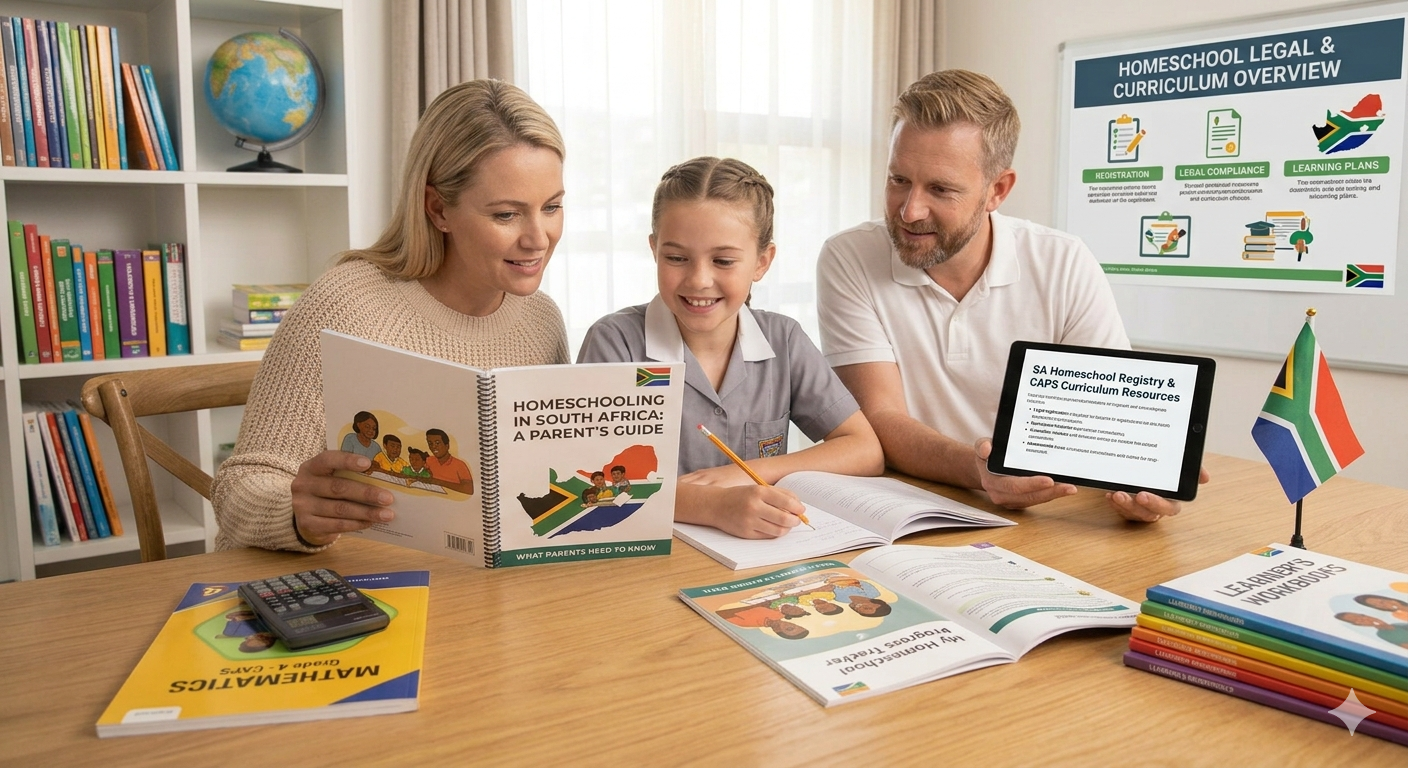
The South African Schools Act provides for parents to apply to the Head of Department of a provincial education department for registration of a learner to receive education at home, subject to the applicable requirements.
Because education administration is handled at provincial level, parents should check the current requirements with their provincial education department before making decisions.
Choosing a Curriculum
One of the biggest decisions a homeschooling family will make is choosing what curriculum or educational programme to follow.
There are several possibilities.
Some families choose a CAPS-aligned programme because they want their child’s learning to broadly follow the curriculum used in South African schools.
Others choose international curricula or specialised homeschooling programmes.
There is no single approach that works for every family.
When comparing programmes, parents should consider:
- The learner’s age and grade
- Academic goals
- Future tertiary education plans
- Assessment requirements
- Subjects offered
- Quality of learning materials
- Teacher or tutor support
- Online learning facilities
- Cost
- Accreditation or recognition claims
Parents should investigate claims about accreditation carefully rather than assuming that a programme is officially recognised simply because a provider uses words such as “accredited” or “international.”
Creating a Homeschooling Schedule
Homeschooling doesn’t necessarily require copying the timetable of a traditional school.
One of its major advantages is flexibility.
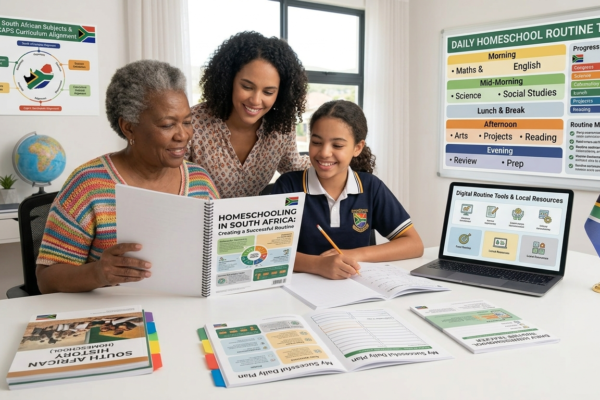
A family could create a schedule that includes formal academic work in the morning and practical or creative activities during the afternoon.
For example:
08:00 – 08:30: Reading
08:30 – 09:30: Mathematics
09:30 – 10:00: Break
10:00 – 11:00: Language
11:00 – 12:00: Science or Social Sciences
12:00 onwards: Lunch, projects, exercise, hobbies or practical learning
The exact timetable should be adapted to the learner and the family’s circumstances.
Homeschooling Is More Than Textbooks
One of the biggest misconceptions about homeschooling is that learning must happen entirely through worksheets and textbooks.
Real-world experiences can provide valuable learning opportunities.
Cooking can involve mathematics, measurement and science.
Gardening can introduce biology and environmental science.
Shopping can teach budgeting and financial literacy.
A family trip can become an opportunity to learn about geography, history and culture.
Technology can introduce learners to research, coding, digital design and other modern skills.
Social Development Still Matters
Parents sometimes worry that homeschooling could limit social interaction.
This does not have to be the case.
Homeschooling families can participate in sports, clubs, community activities, cultural organisations, study groups, educational outings and other activities.
The objective is to ensure that children have opportunities to interact with other people, develop communication skills and participate in activities outside the home.
Online Learning Can Support Homeschooling
Technology has opened up enormous possibilities for homeschooling families.
Learners can access online lessons, educational videos, digital textbooks, quizzes, assignments and interactive activities.
Parents can also use online resources to supplement subjects they may not feel confident teaching themselves.
A good homeschooling programme can therefore combine parental involvement with technology, tutors and other educational resources.
Plan for the Future
Parents should think beyond the current school year.
If your child eventually wants to attend university, college, a TVET institution or another form of further education, investigate the relevant admission and qualification requirements early.
Understanding future requirements can help parents make better decisions about curriculum, subjects, assessment and educational pathways.
Final Thoughts
Homeschooling can offer South African families an exciting opportunity to create a flexible and personalised learning environment.
But successful homeschooling requires planning.
Parents need to understand the applicable legal requirements, select appropriate learning resources, establish a consistent routine and regularly monitor their child’s progress.
There is no single “perfect” homeschooling method.
The best approach is one that provides meaningful learning, supports the child’s development and prepares them for the next stage of their educational journey.
Our-School is committed to helping South African families discover practical approaches to homeschooling, online learning and lifelong education.

You may also like
Homeschooling Costs in South Africa:

Homeschooling and Socialization: