
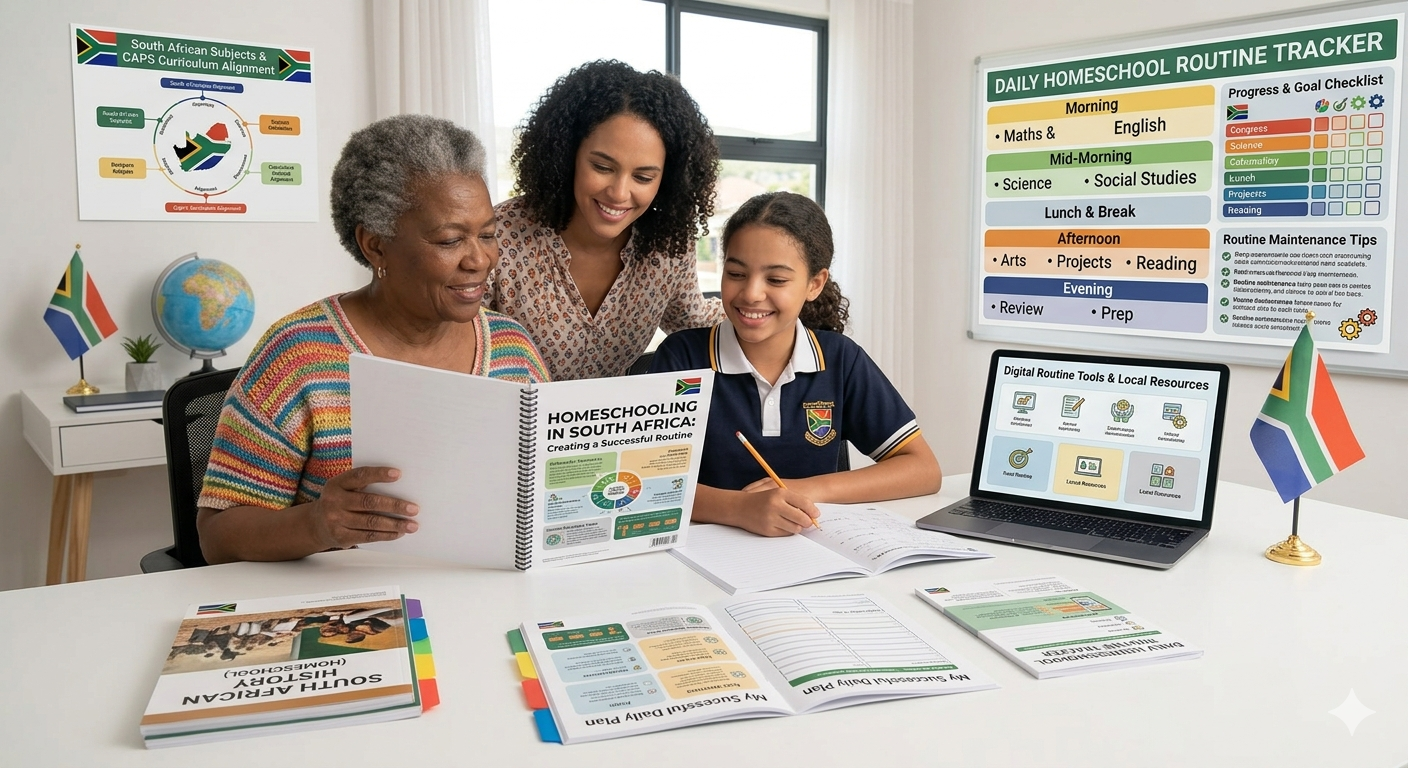
Creating a Successful Homeschooling Routine in South Africa
One of the biggest advantages of homeschooling is flexibility. Families can organise learning around their own circumstances instead of following a traditional school timetable.
However, flexibility doesn’t mean having no routine.
A consistent homeschooling routine can help children understand what is expected of them, develop good study habits and make the school day feel more organised.
The key is finding a balance between structure and flexibility.
Why Is a Homeschooling Routine Important?
Children generally benefit from knowing what comes next.
A predictable routine can help reduce distractions and make it easier for learners to concentrate on their schoolwork.
A good routine can also help parents manage homeschooling alongside household responsibilities, work and other commitments.
Your routine doesn’t have to look exactly like a traditional school day.
The goal is to create a system that works for your family.
Start With Your Child’s Age
The ideal homeschooling schedule will depend heavily on the child’s age.
Younger learners may benefit from shorter learning sessions with frequent breaks.
Older learners may be able to work independently for longer periods.
For example, a younger child might spend 20–30 minutes on a particular activity before moving on to something different, while an older learner may be comfortable completing a longer mathematics or science lesson.
Avoid assuming that a child needs to sit at a desk for six or seven hours to receive a quality education.
Effective learning is more important than simply counting hours.
Create a Daily Schedule
A simple schedule can provide structure without making homeschooling stressful.
For example:
08:00 – 08:30
Reading and language activities
08:30 – 09:30
Mathematics
09:30 – 10:00
Break
10:00 – 11:00
Science
11:00 – 12:00
Language or writing
12:00 – 13:00
Lunch and relaxation
13:00 – 14:00
Creative or practical learning
14:00 onwards
Exercise, hobbies, projects or independent reading
This is simply an example.
Your family’s schedule can be completely different.
Don’t Forget Breaks
Breaks aren’t wasted time.
Children need opportunities to move, relax and reset their attention.
Long periods of continuous study can lead to frustration and reduced concentration.
Encourage children to get up, stretch, play outside, have a snack or simply take a few minutes away from their learning materials.
Physical activity can also be incorporated into the day.
Create a Dedicated Learning Space
You don’t necessarily need an entire room for homeschooling.
A suitable learning area could be a desk in a bedroom, dining room, study or another quiet part of the home.
Try to keep essential materials together.
A basic learning space might include:
- Desk or table
- Comfortable chair
- Books
- Stationery
- Laptop or tablet
- Internet access
- Printer if required
- Storage for worksheets and assignments
The most important thing is that the space allows your child to concentrate.
Make a Weekly Plan
Planning the entire week can be easier than deciding every morning what your child should learn.
At the beginning of the week, identify the subjects and topics that need to be covered.
For example:
Monday: Mathematics, English, Science
Tuesday: Mathematics, Afrikaans, Social Sciences
Wednesday: Mathematics, English, Technology
Thursday: Mathematics, Life Skills, Science
Friday: Revision, projects and assessments
A weekly plan also makes it easier to identify whether your child is falling behind.
Use a Combination of Learning Methods
Homeschooling doesn’t have to consist entirely of textbooks.
A strong routine can combine different types of learning.
For example:
Reading: Books and digital articles
Mathematics: Worksheets and interactive exercises
Science: Videos, experiments and practical projects
History: Books, documentaries and research
Languages: Reading, writing and conversation
Technology: Online lessons and practical computer activities
Using different methods can make learning more engaging.
Build Independent Learning Skills
As children get older, parents can gradually encourage them to take greater responsibility for their education.
Teach learners how to:
- Follow a timetable
- Organise their schoolwork
- Set goals
- Complete assignments
- Research information
- Check their own work
- Prepare for tests
- Manage their time
These skills are valuable far beyond homeschooling.
They can help learners at university, in further education and eventually in the workplace.
Don’t Try to Recreate a Traditional School
One common mistake new homeschooling parents make is trying to recreate a classroom inside the home.
Homeschooling provides an opportunity to do things differently.
If your child understands a topic quickly, you don’t necessarily need to spend hours repeating it.
If they are struggling with something, you can slow down and approach it from another direction.
The flexibility of homeschooling allows education to be adapted to the learner.
Include Practical Learning
Some of the best learning opportunities may not look like traditional schoolwork.
Cooking can teach fractions, measurements and chemistry.
Gardening can introduce biology and environmental science.
Shopping can teach budgeting and percentages.
Planning a family outing can involve geography, mathematics and research.
Building or repairing something can develop problem-solving and practical skills.
These experiences can complement formal academic learning.
Schedule Time for Exercise and Social Activities
A homeschooling routine should include more than academic work.
Children need physical activity, hobbies, friendships and opportunities to interact with others.
Consider including:
- Sport
- Swimming
- Art
- Music
- Clubs
- Community activities
- Educational outings
- Play
- Group learning
A balanced routine can support the child’s overall development.
Be Flexible When Life Happens
No family has a perfect week.
Children may become tired.
Appointments may arise.
Family responsibilities may change.
Some days simply won’t go according to plan.
That’s one of the advantages of homeschooling.
If you miss a lesson, you can adjust the schedule.
The objective is not perfection.
The objective is consistent progress.
Review the Routine Regularly
Your child’s needs will change over time.
A routine that works perfectly today may not work six months from now.
Review your schedule regularly.
Ask:
Is my child coping with the workload?
Are there enough breaks?
Are certain subjects taking too long?
Does my child need more independent learning time?
Are we making time for exercise and social activities?
Small adjustments can make a major difference.
Final Thoughts
A successful homeschooling routine doesn’t need to be complicated.
Start with a basic structure, establish realistic learning periods and allow enough flexibility for your child’s individual needs.
Remember that homeschooling is about creating an effective learning environment — not about reproducing the exact timetable of a traditional school.
With good planning, patience and flexibility, homeschooling can become an enjoyable and rewarding educational experience for both parents and children.
Our-School is committed to supporting South African families with practical homeschooling information, online learning resources and educational tools for today’s learners.

You may also like
Homeschooling Costs in South Africa:

Homeschooling and Socialization: