
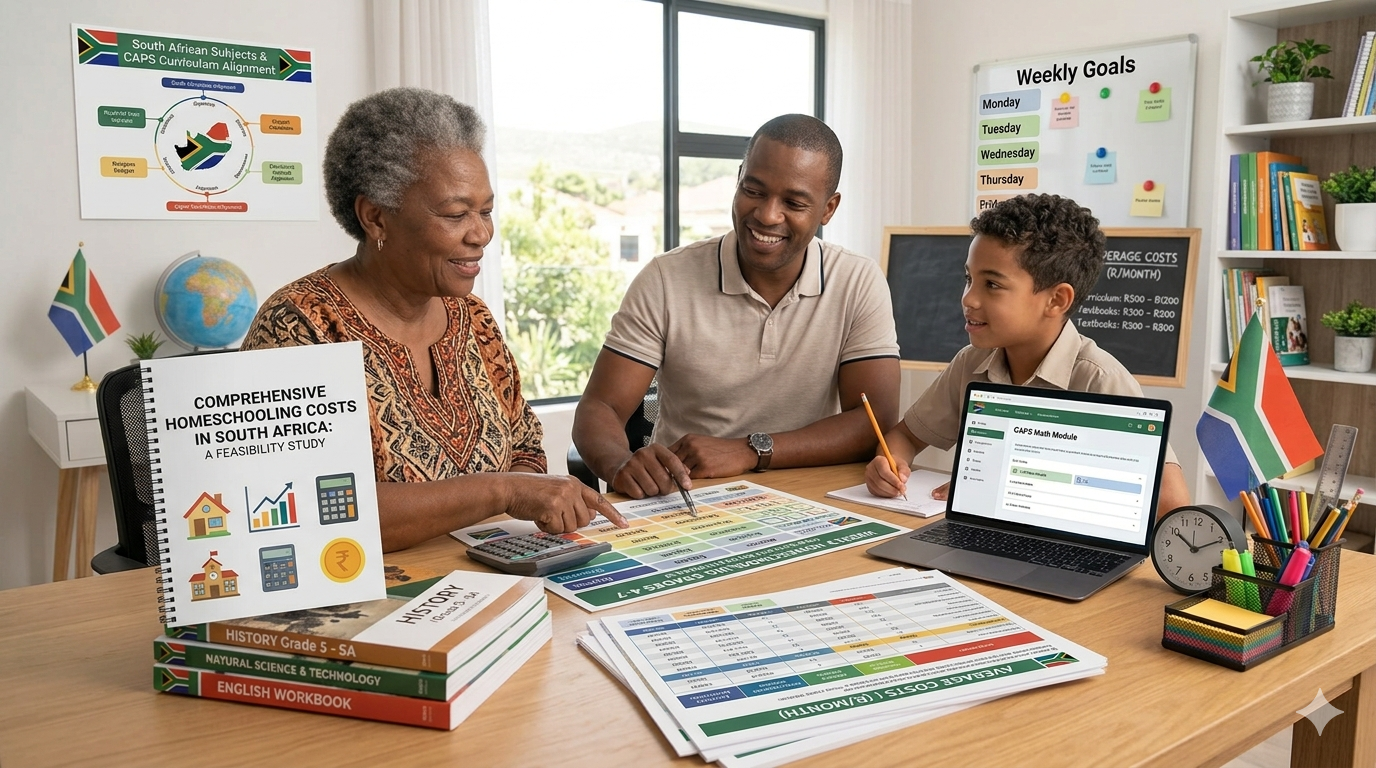
Homeschooling Costs in South Africa:
How to Plan Your Education Budget
One of the biggest questions parents have when considering homeschooling is:
“How much does homeschooling cost in South Africa?”
The answer can vary significantly.
Some families homeschool using affordable or free resources, while others invest in comprehensive online programmes, tutors, technology, textbooks and additional educational activities.
The important thing is to look at the total cost of your homeschooling plan, rather than focusing on the price of a single curriculum.
Is Homeschooling Cheaper Than Private School?
It can be, but there is no universal answer.
Homeschooling costs depend on the approach your family chooses.
A parent who uses freely available educational resources and existing household technology may spend relatively little.
Another family might pay for a comprehensive curriculum, tutoring, assessments, devices, internet access and educational outings.
The flexibility of homeschooling means that families can potentially design an education budget around their circumstances.
The Main Costs to Consider
Before starting, create a realistic list of potential expenses.
1. Curriculum
Your curriculum may be your largest educational expense.
Depending on the programme, you may pay:
- Once-off fees
- Monthly subscription fees
- Annual fees
- Subject-specific fees
- Registration fees
- Assessment fees
Always determine exactly what is included before enrolling.
2. Textbooks and Workbooks
Even when using an online curriculum, additional books can be useful.
Depending on the learner’s age and subjects, you may need:
- Textbooks
- Workbooks
- Reading books
- Revision guides
- Exercise books
- Stationery
Buying second-hand books or using libraries can sometimes reduce costs.
3. Computer or Tablet
Technology is increasingly useful for homeschooling.
A computer or tablet can provide access to:
- Online lessons
- Educational videos
- Digital textbooks
- Research
- Online assessments
- Educational applications
- Learning platforms
You don’t necessarily need the most expensive device.
The important thing is to ensure that the device can comfortably run the software and platforms your child needs.
4. Internet Access
If your homeschooling programme relies heavily on online learning, internet access becomes an important part of the education budget.
Consider:
- Monthly data costs
- Home internet
- Mobile data
- Backup connectivity
Families should estimate how much data their chosen learning platform requires before selecting an internet package.
Video lessons can consume considerably more data than reading online material.
5. Printing
Some homeschooling programmes involve worksheets, assignments and other printable material.
If your child completes a lot of written work, printer ink and paper can become an ongoing expense.
Parents can reduce printing costs by using digital worksheets where appropriate.
However, some learners may benefit from having physical material to write on.
6. Tutoring
Parents don’t have to teach every subject themselves.
A tutor can provide additional assistance when a learner struggles with a particular subject.
Tutoring costs can vary depending on the tutor, subject, level and whether lessons are conducted online or in person.
Instead of paying for tutoring across every subject, some families choose to use tutors only for specific areas where additional assistance is needed.
7. Educational Activities
Learning doesn’t need to happen entirely at home.
Educational outings can provide valuable experiences.
Potential activities include:
- Museums
- Libraries
- Science centres
- Historical sites
- Nature reserves
- Zoos
- Art galleries
- Educational workshops
Some activities are free or inexpensive, while others may require entrance fees and transport costs.
8. Sports and Extracurricular Activities
Children need opportunities to develop interests outside academic subjects.
Sports, music, art, dance and other activities can form an important part of a balanced education.
When planning your budget, consider membership fees, equipment, uniforms, lessons and transport.
Create a Monthly Homeschooling Budget
A simple budget can help prevent unexpected expenses.
For example:
| Expense | Estimated Monthly Cost |
|---|---|
| Curriculum | R___ |
| Internet/Data | R___ |
| Books & Workbooks | R___ |
| Printing | R___ |
| Tutoring | R___ |
| Activities | R___ |
| Sports/Hobbies | R___ |
| Other Educational Costs | R___ |
| Total | R___ |
The amounts will be different for every family.
The purpose of the budget is to understand your own expected costs.
Don’t Forget Hidden Costs
Some expenses aren’t immediately obvious.
Parents should also consider:
- Transport
- Educational equipment
- Art supplies
- Science experiment materials
- Headphones
- Computer accessories
- Storage
- Examination or assessment expenses
- Occasional educational outings
These smaller expenses can add up over a year.
Free and Low-Cost Resources
Homeschooling doesn’t have to mean purchasing everything.
Parents can investigate free educational resources, public libraries, educational videos, open learning materials and community activities.
However, always check the quality and suitability of free resources.
Free doesn’t automatically mean appropriate.
Consider the Value of Your Time
There is another cost that can be easy to overlook:
your time.
Homeschooling can require significant parental involvement, particularly with younger learners.
Parents may need to prepare lessons, supervise activities, mark assignments, organise resources and track progress.
If you work from home or have other responsibilities, think carefully about how homeschooling will fit into your daily schedule.
Avoid Buying Everything at Once
New homeschooling parents can easily become overwhelmed by the amount of educational material available.
You don’t need to purchase every textbook, programme and educational gadget you see.
Start with the essentials.
As you discover your child’s learning needs, add resources where they are genuinely useful.
This approach can save money and prevent your home from becoming overloaded with unused educational material.
Plan for the Full School Year
Instead of looking only at monthly costs, calculate the estimated cost for the entire year.
For example:
Monthly recurring expenses × 12
Then add annual expenses such as curriculum fees, textbooks, assessments and equipment.
This gives you a much clearer picture of the actual cost of your homeschooling plan.
Homeschooling Can Be Flexible
One of the greatest advantages of homeschooling is the ability to adapt your education plan to your family’s circumstances.
You don’t necessarily need an expensive private tutor for every subject.
You may not need the newest laptop.
You don’t need an enormous collection of textbooks.
A carefully planned combination of curriculum material, technology, books, practical activities and parental support can create a meaningful learning environment.
Final Thoughts
The cost of homeschooling in South Africa depends largely on the choices your family makes.
Before starting, identify your essential expenses, investigate curriculum options carefully and create a realistic education budget.
Remember to consider both obvious costs — such as curriculum and books — and less obvious expenses such as internet access, tutoring, transport and educational activities.
Most importantly, don’t assume that spending more automatically produces a better education.
Good homeschooling is about using the right resources effectively to meet your child’s educational needs.
With careful planning, families can create a structured, engaging and personalised homeschooling experience without allowing educational costs to become unnecessarily overwhelming.
Our-School is committed to helping South African families discover practical homeschooling solutions, online learning opportunities and educational resources for learners of all ages.

You may also like

Homeschooling and Socialization:
Creating a Successful Homeschooling Routine in South Africa