Understanding the CAPS Curriculum in South Africa: A Complete Guide for Parents and Learners
“Education is the most powerful weapon which you can use to change the world.” – Nelson Mandela
For parents, guardians and learners in South Africa, understanding the school curriculum is an important part of making informed educational decisions. Whether your child attends a public school, private school, follows an online learning programme or is considering another form of education, the CAPS curriculum is one of the most important education frameworks to understand.
CAPS stands for Curriculum and Assessment Policy Statement. It provides the curriculum and assessment requirements followed by South African schools from Grade R through Grade 12.
But what exactly does CAPS involve, and how can parents help their children succeed within the system?
What Is the CAPS Curriculum?
The CAPS curriculum is the national curriculum framework developed and implemented by the South African Department of Basic Education.
It sets out what learners are expected to learn in each grade and subject. It also provides guidance on the content that should be covered, the skills learners should develop and how learning should be assessed.
CAPS is designed to provide greater consistency across South African schools while giving teachers a structured framework for delivering lessons.
The curriculum covers the different stages of schooling, from the Foundation Phase through the Intermediate and Senior Phases and ultimately the Further Education and Training Phase.
Why Is CAPS Important?
A national curriculum provides a common educational foundation for learners across South Africa.
CAPS helps establish:
- Clear learning objectives for each grade.
- Subject-specific content and requirements.
- Guidelines for teaching and assessment.
- A structured progression from one grade to the next.
- Preparation for further education, training and employment.
- A framework against which learner performance can be assessed.
For parents, understanding these requirements can make it easier to monitor a child’s progress and identify areas where additional support may be needed.
CAPS Subjects and Learning Areas
The subjects learners study depend on their grade and phase.
In the earlier grades, learners develop fundamental skills such as language, mathematics and life skills.
As learners progress through school, subjects become increasingly specialised. Depending on the phase and grade, learners may study subjects such as:
- Home Language
- First Additional Language
- Mathematics
- Mathematical Literacy
- Physical Sciences
- Life Sciences
- Geography
- History
- Accounting
- Business Studies
- Economics
- Life Orientation
- Information Technology
- Computer Applications Technology
- Creative Arts
- Tourism
- Consumer Studies
- Agricultural Sciences
The exact subject combination depends on the learner’s grade and schooling pathway.

CAPS Is About More Than Memorising Information
One common misconception is that curriculum-based education is simply about memorising information for examinations.
While learners certainly need to understand and remember important knowledge, successful learning involves much more.
Learners also need to develop:
- Problem-solving abilities.
- Communication skills.
- Critical thinking.
- Research skills.
- Numeracy.
- Literacy.
- Independent learning habits.
- The ability to apply knowledge to real-world situations.
These skills become increasingly important as learners move towards higher education, vocational training and the workplace.
The Importance of Assessment
Assessment is an important part of the CAPS system.
Assessment allows teachers and parents to understand whether learners are achieving the required learning outcomes.
Depending on the grade and subject, assessment can include:
- Class activities.
- Tests.
- Projects.
- Assignments.
- Practical activities.
- Oral presentations.
- Investigations.
- Examinations.
Parents should remember that one poor test result does not necessarily mean a learner is failing. Looking at the learner’s overall progress can provide a much better picture.
How Parents Can Support a CAPS Learner
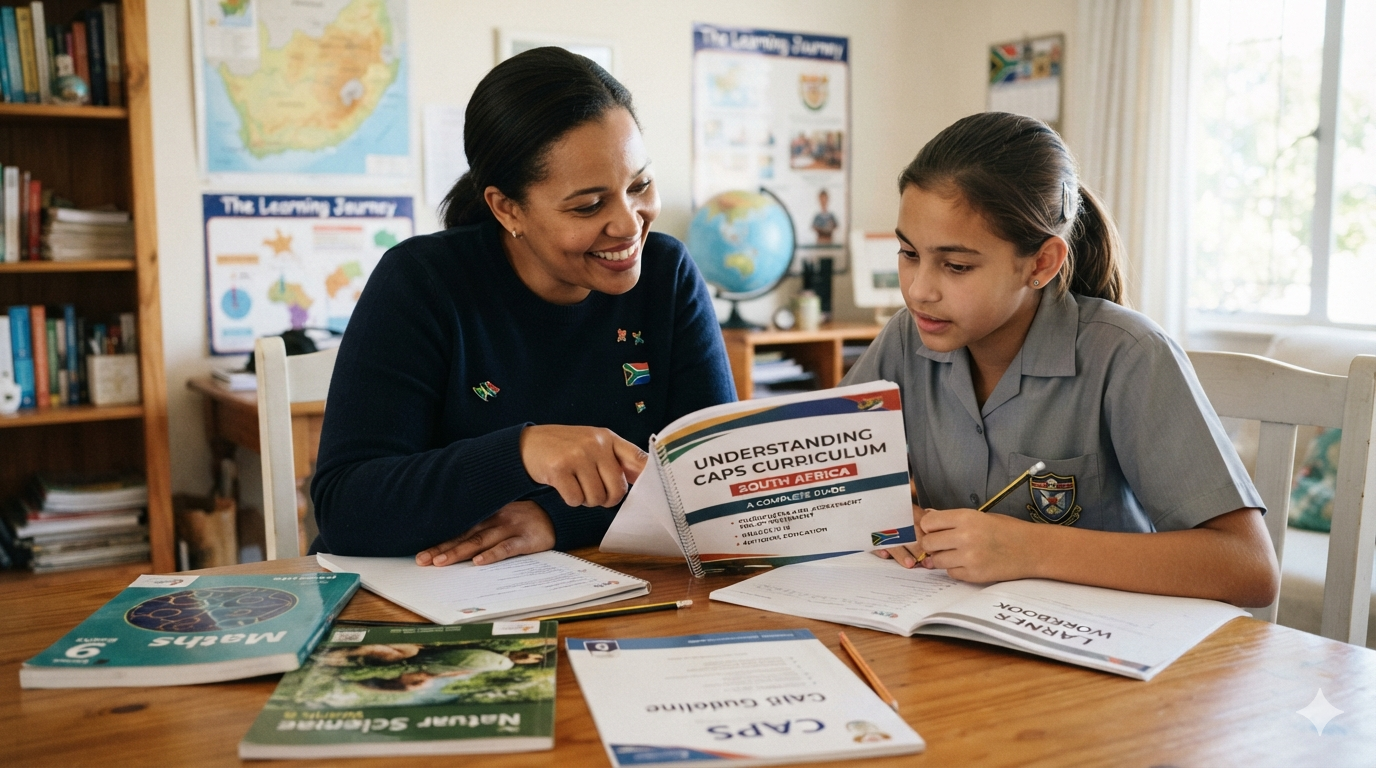
Parents don’t need to be teachers to play an important role in their child’s education.
One of the most valuable things a parent can provide is a positive learning environment.
Try to establish a regular study routine and encourage your child to complete schoolwork consistently rather than leaving everything until examination time.
Parents can also:
- Encourage daily reading.
- Ask children about what they learned at school.
- Help them organise assignments and projects.
- Provide a quiet place to study.
- Encourage the use of reliable educational resources.
- Monitor areas where the learner is struggling.
- Celebrate improvement rather than focusing only on marks.
- Encourage questions and curiosity.
Most importantly, help your child understand that making mistakes is part of learning.
Using Technology to Support CAPS Learning
Technology has transformed the way learners can access educational information.
Online learning platforms, educational videos, digital study resources, practice tests and interactive learning tools can supplement traditional classroom teaching.
For learners who need additional help with a particular subject, online education can provide another opportunity to revisit difficult concepts at their own pace.
This is particularly useful when a learner needs additional practice in areas such as mathematics, languages, science or accounting.
However, technology should support learning rather than replace good study habits. Learners still need discipline, concentration and regular practice.
What Happens After Grade 12?
For many learners, Grade 12 represents an important transition point.
The National Senior Certificate can provide a pathway towards further study, depending on the learner’s results and the admission requirements of the institution or programme they wish to enter.
Possible pathways after school can include:
- Universities.
- TVET colleges.
- Private colleges.
- Occupational training.
- Apprenticeships.
- Learnerships.
- Entrepreneurship.
- Employment.
The most important lesson is that education does not end when school ends.
The world of work continues to change, and lifelong learning is becoming increasingly valuable.
CAPS and Online Learning
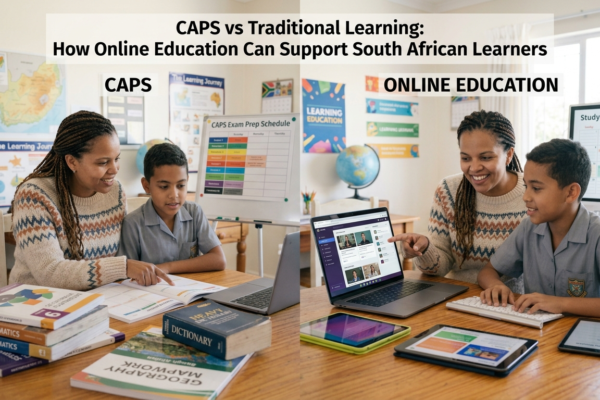
Online learning can work alongside traditional CAPS education by giving learners additional flexibility and access to educational resources.
An online learner may be able to revisit lessons, practise difficult topics and learn at a pace that suits their individual needs.
For parents considering online education, it is important to investigate whether the programme follows the curriculum requirements applicable to the learner and whether its assessment and progression arrangements are appropriate.
Always check the current requirements with the relevant education provider and official South African education authorities before making important schooling decisions.
Tips for Helping Your Child Succeed
Success at school isn’t created overnight. It comes from consistent habits.
Here are five simple principles that can make a difference:
1. Create a routine.
A consistent study schedule helps learners develop discipline.
2. Encourage reading.
Reading improves vocabulary, comprehension and general knowledge.
3. Practise regularly.
Regular practice is particularly important for subjects such as mathematics, accounting and science.
4. Ask for help early.
If a learner is struggling with a concept, getting assistance early can prevent the problem from becoming bigger.
5. Focus on progress.
Every learner develops at a different pace. Improvement deserves recognition.
The Future of Education in South Africa
South African education continues to evolve as technology, employment requirements and society change.
The ability to learn independently is becoming increasingly important. Learners who develop curiosity, adaptability, communication skills and problem-solving abilities will be better prepared for a rapidly changing world.
CAPS provides the structured foundation, but parents, teachers and learners all have an important role to play in turning that foundation into meaningful education.
As Nelson Mandela famously reminded the world:
“Education is the most powerful weapon which you can use to change the world.”
Final Thoughts
Understanding the CAPS curriculum doesn’t have to be complicated.
Parents who understand what their children are expected to learn can provide better support, identify challenges earlier and encourage positive study habits.
For learners, the goal should not simply be to pass the next test. The real goal is to understand, apply and retain knowledge while developing the skills needed for life beyond the classroom.
Education is a journey — and with the right support, every learner has the opportunity to keep learning, growing and building a brighter future.

You may also like

How to Help Your Child Succeed With the CAPS Curriculum