
CAPS Curriculum Explained:
What South African Parents Need to Know
Choosing the right education pathway for your child can feel overwhelming, especially when there are so many different curriculum options available. For parents considering homeschooling, online learning, private education or simply wanting to better understand what their child is learning at school, the CAPS curriculum is an important place to start.
CAPS stands for Curriculum and Assessment Policy Statement. It provides the framework used by South African public schools to guide what learners should be taught, when they should be taught and how their progress should be assessed.
What Is the CAPS Curriculum?
CAPS is the national curriculum framework used across South African schools. It sets out the content and skills that learners are expected to develop in each subject and grade.
The curriculum covers the Foundation Phase, Intermediate Phase, Senior Phase and Further Education and Training (FET) Phase.
For parents, understanding CAPS can be particularly useful because it provides a benchmark for evaluating educational resources, tutoring programmes and homeschooling materials.
Why Is CAPS Important?
One of the biggest advantages of a structured curriculum is consistency.
CAPS provides teachers and learners with clear learning objectives. It helps establish what knowledge and skills should be covered during each school year.
For parents, this can make it easier to:
- Track their child’s academic progress
- Identify areas where additional support may be needed
- Find suitable textbooks and learning resources
- Choose appropriate tutoring programmes
- Supplement classroom learning at home
- Compare educational programmes
- Plan homeschooling resources around recognised curriculum requirements
CAPS and Homeschooling
CAPS is also relevant to many South African families who homeschool or use a combination of homeschooling and online education.
Parents may choose to follow CAPS-aligned resources because they provide a familiar and structured learning pathway.
However, parents should carefully investigate the requirements applicable to their particular homeschooling arrangement and province. Following CAPS content does not automatically mean that every homeschooling programme has the same legal or assessment status as attending a public school.
The important thing is to understand both the curriculum content and the education requirements that apply to your child’s circumstances.
How Can Parents Support CAPS Learning at Home?
Learning doesn’t have to stop when the school day ends.
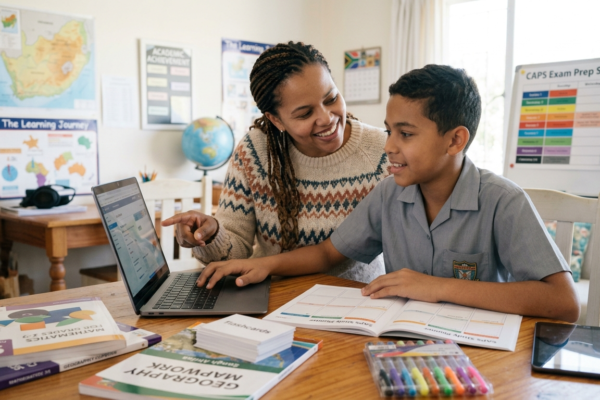
Parents can reinforce classroom learning through simple activities such as reading together, practising mathematics, conducting science experiments, using educational videos and discussing current events.
Online learning can also provide additional opportunities for learners to practise concepts at their own pace.
For example, a learner struggling with fractions could revisit the topic using an online lesson, complete additional exercises and then return to the topic later for revision.
This can be particularly valuable because children don’t all learn at exactly the same speed.
Don’t Focus Only on Memorisation
Although knowing the required content is important, education should be about more than memorising information for a test.
Parents should encourage learners to:
- Ask questions
- Explain concepts in their own words
- Solve problems
- Research information
- Think critically
- Apply knowledge to real-world situations
- Develop communication and digital skills
These abilities can help learners beyond the classroom and prepare them for further education and eventually the workplace.
Using Technology to Support CAPS Learning
Technology has changed the way learners can access educational material.
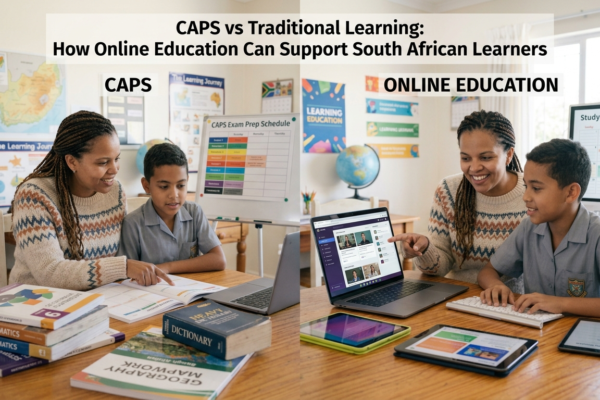
A learner can now supplement traditional textbooks with online lessons, interactive quizzes, educational videos, digital assignments and revision resources.
For parents, the key is choosing resources that are age-appropriate, reliable and aligned with the learner’s educational needs.
Technology should complement learning rather than simply replace traditional teaching.
A Partnership Between Parents, Teachers and Learners
The most effective education environment is one where everyone understands the learner’s needs.
Teachers provide professional guidance and classroom instruction. Parents can provide support, encouragement and additional learning opportunities at home. Learners themselves need to become increasingly responsible for their own education.
When these three elements work together, the curriculum becomes more than a list of subjects — it becomes a framework for developing knowledge, confidence and lifelong learning skills.
Final Thoughts
Understanding CAPS can help South African parents make better-informed decisions about their children’s education.
Whether your child attends a public school, private school, uses online learning or follows a homeschooling pathway, knowing what learners are expected to study can help you identify gaps, find additional resources and support your child’s academic development.
Education is changing rapidly, and parents have more learning resources available to them than ever before.
The goal should not simply be to help a child pass the next test. It should be to help them develop the knowledge, skills, confidence and curiosity they need for the future.
Our-School is committed to helping South African learners, parents and educators access useful educational resources, online learning opportunities and practical tools for lifelong learning.