CAPS vs Traditional Learning: How Online Education Can Support South African Learners
“The beautiful thing about learning is that nobody can take it away from you.” – B.B. King
Education in South Africa is changing.
While the CAPS curriculum remains the structured national curriculum used across the schooling system, learners today have access to something previous generations never had on the same scale: online education and digital learning resources.
For parents, this creates an exciting opportunity.
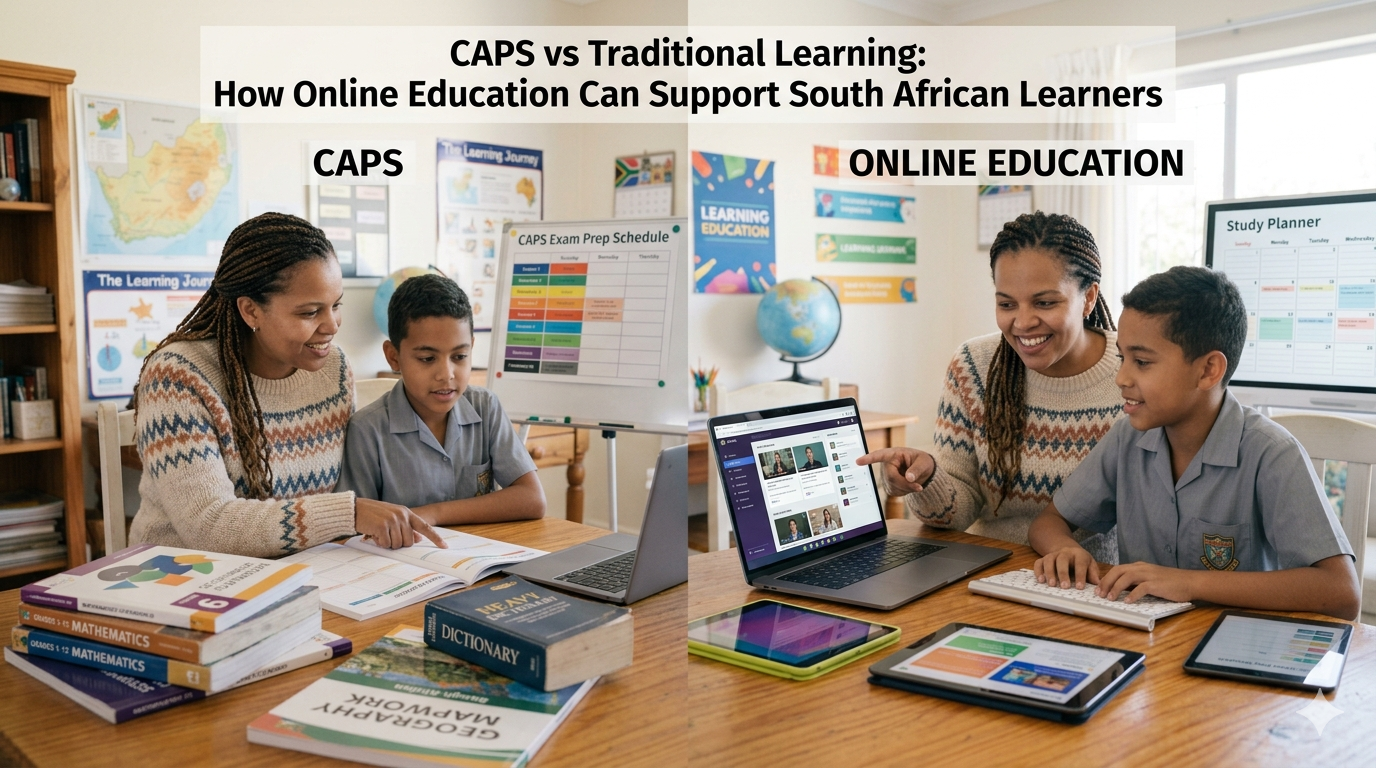
Online learning doesn’t necessarily mean replacing traditional schooling. In many cases, it can be used to support, reinforce and extend what learners are already learning through CAPS.
The Department of Basic Education describes CAPS as a comprehensive curriculum and assessment framework forming part of the National Curriculum Statement for Grades R–12. The Department provides CAPS documentation across the different school phases and subjects.
So how can online learning fit into the picture?
What Is Online Learning?
Online learning is education delivered partly or entirely through digital technology.
Depending on the programme, learners may access:
- Video lessons.
- Digital textbooks.
- Interactive activities.
- Online quizzes.
- Assignments.
- Practice tests.
- Educational presentations.
- Downloadable study resources.
- Teacher or tutor support.
- Progress tracking.
For a South African learner following CAPS, these resources can provide an additional layer of learning alongside school.
Why Online Learning Can Complement CAPS
Every learner is different.
Some learners understand a concept the first time it is explained.
Others need to hear the explanation again.
Some learn best by reading.
Others learn better by watching a demonstration or completing an interactive exercise.
This is where online education can be particularly useful.
A learner can often pause a lesson, replay an explanation, practise a concept and return to difficult material later.
Learning doesn’t have to stop when the school bell rings.
1. Learners Can Learn at Their Own Pace
One of the biggest advantages of digital learning is flexibility.
In a traditional classroom, a teacher has to teach a lesson to a group of learners. Some learners may understand quickly, while others may need more time.
Online resources can give learners an opportunity to revisit the material.
For example, if a learner struggles with algebra, they can work through additional explanations and practice exercises before moving on.
Likewise, a learner who already understands a topic can potentially progress to more challenging material.
2. Difficult Subjects Can Be Practised More Often
Some subjects require repetition.
Mathematics is an obvious example.
The same applies to:
- Accounting.
- Physical Sciences.
- Languages.
- Economics.
- Computer-related subjects.
Online learning can make it easier to practise regularly.
Instead of completing one classroom exercise and moving on, learners can access additional activities to strengthen their understanding.
3. Video Can Make Complicated Concepts Easier to Understand
A well-designed educational video can combine:
Visual explanations + spoken instruction + examples + demonstrations.
This can be particularly useful for concepts that are difficult to explain using text alone.
For example, a science lesson could demonstrate an experiment.
A mathematics lesson could work through a calculation step-by-step.
A geography lesson could use maps and animations.
A computer lesson could demonstrate software on screen.
The objective isn’t to replace the teacher.
It is to give the learner another way of understanding the concept.
4. Online Learning Can Help With Revision
Revision is essential as learners prepare for assessments.
Online platforms can help learners organise revision around specific subjects and topics.
A learner might spend one session reviewing a concept, another completing practice questions and another testing their knowledge.
This approach can make revision more structured.
The Department of Basic Education also provides digital and study resources, including Mind the Gap study guides, workbooks and other learning materials through its education resources.
5. Parents Can Become More Involved
Online education can also give parents greater visibility into their child’s learning.
Depending on the platform, parents may be able to see:
- Which lessons have been completed.
- Which quizzes have been attempted.
- Which areas are causing difficulty.
- How consistently the learner is studying.
- Whether assignments have been completed.
This can make it easier to identify problems before they become serious.
6. Learning Can Continue During School Breaks
School holidays provide an opportunity for learners to relax — but they can also be used for light educational activities.
This doesn’t mean children should spend their entire holiday studying.
Instead, parents can encourage simple activities such as:
- Reading.
- Educational videos.
- Revision games.
- Online quizzes.
- Research projects.
- Creative projects.
- Practical mathematics.
Even a small amount of regular learning can help learners stay connected with their subjects.
7. Online Learning Can Help Learners Prepare for Grade 12
The Further Education and Training phase covers Grades 10–12, and the CAPS framework includes a wide range of subjects available to learners depending on their subject choices.
As learners approach Grade 12, organisation becomes increasingly important.
They need to manage:
- Multiple subjects.
- Assignments.
- Projects.
- Tests.
- Revision.
- Examination preparation.
- Post-school planning.
Online resources can help learners create a structured study routine.
8. It Can Introduce Learners to Digital Skills
There is another benefit that goes beyond the curriculum.
Learners who regularly use technology for education can develop useful digital habits.
They can learn how to:
- Search for information.
- Evaluate online sources.
- Organise digital files.
- Use productivity tools.
- Participate in online learning.
- Communicate digitally.
- Complete online assessments.
- Research independently.
These skills can become valuable later in higher education, employment and entrepreneurship.
9. Online Education Can Support Different Learning Styles
There is no single perfect way to learn.
Some learners prefer:
Reading.
Others prefer:
Watching.
Others prefer:
Doing.
The best online learning environments can combine several approaches.
A lesson might include a video explanation, written notes, an interactive activity and a quiz.
This gives learners multiple opportunities to engage with the same concept.
10. But Online Learning Still Requires Discipline
Technology isn’t a magic solution.
Giving a child a laptop does not automatically make them a successful learner.
Online education works best when learners develop good habits.
They need to learn how to:
- Manage their time.
- Avoid distractions.
- Complete lessons.
- Take notes.
- Practise regularly.
- Ask for assistance.
- Review mistakes.
- Meet deadlines.
Parents can help by creating a structured learning routine.
How to Create a Simple Home Learning Routine
A simple weekday routine could look like this:
15 minutes – Reading
30 minutes – Online lesson
15 minutes – Practice questions
10 minutes – Review
This doesn’t need to happen every day for every subject.
The routine should be adapted to the learner’s age, grade, school workload and individual needs.
The most important factor is consistency.
How Parents Should Choose an Online Education Programme
Before paying for an online programme, parents should investigate it carefully.
Ask:
Does the programme clearly explain what curriculum it follows?
Which grades and subjects are covered?
Who creates or delivers the lessons?
How is learner progress assessed?
Is there teacher or tutor support?
Are assignments and tests included?
What happens if the learner falls behind?
Is the content regularly reviewed and updated?
And importantly:
Does the programme make claims about accreditation, certification or recognition that can be independently verified?
Parents should always check important education and qualification claims with the relevant institution or official authority.
CAPS and the Future of Digital Education
The Department of Basic Education’s current online resources demonstrate that digital education is already part of South Africa’s broader educational environment. Its official resources include curriculum documents, digital content, workbooks and study guides.
The future is therefore unlikely to be about choosing between “traditional education” and “online education.”
Instead, the future may increasingly involve combining the strengths of both.
Teachers provide human guidance.
Parents provide encouragement.
Schools provide structure.
Online platforms provide additional flexibility and resources.
And learners remain at the centre of the process.
The Best Technology Is the Technology That Helps a Learner Learn
It is easy to become impressed by flashy educational technology.
But technology should never be the objective.
Learning is the objective.
A simple online lesson that helps a learner finally understand fractions can be more valuable than an expensive platform filled with features that the learner never uses.
The question should always be:
“Does this help the learner understand, practise and apply what they are learning?”
If the answer is yes, technology can become a powerful educational tool.
Final Thoughts
The CAPS curriculum provides South African learners with a structured national curriculum framework.
Online learning can complement that framework by giving learners additional opportunities to practise, revise, explore and learn at their own pace.
Used correctly, digital education isn’t about replacing teachers.
It is about giving learners more opportunities to learn.
For parents, the goal should be simple:
Support your child’s education.
Encourage curiosity.
Build good study habits.
Use technology wisely.
And most importantly, help your child discover that learning isn’t something that ends when they leave the classroom.
Learning is a lifelong advantage.

You may also like

How to Help Your Child Succeed With the CAPS Curriculum