How to Market Your Online Store:
Social Media, SMS, Email and Marketplaces
Building an online store is only the beginning.
Once your website is ready, the next challenge is getting people to discover your products and encouraging them to become customers.
The good news is that modern eCommerce businesses have access to a wide range of marketing channels.
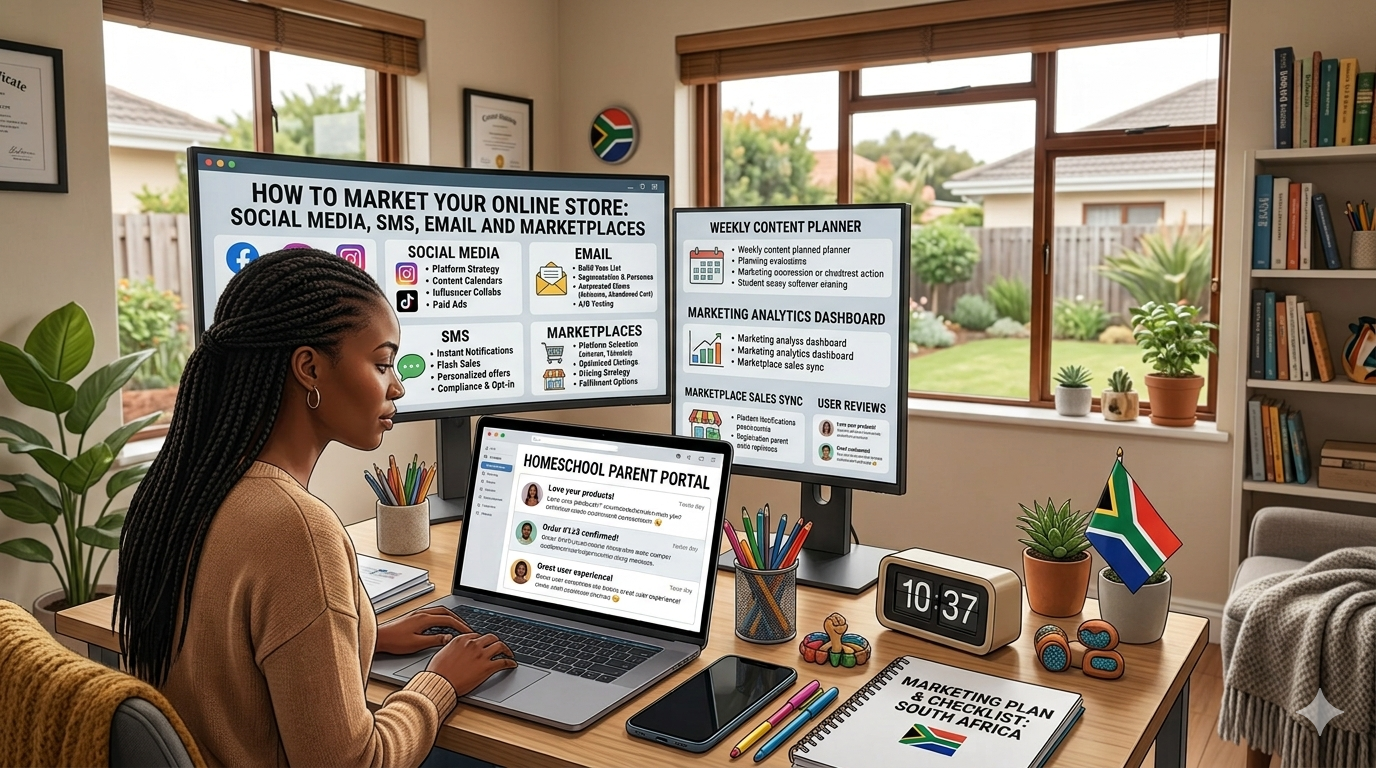
You can promote your products through social media, SMS, email marketing and online marketplaces — while using your own website as the central hub for your business.
The key is not simply to advertise everywhere.
The key is to understand where your customers are and how to reach them effectively.
1. Social Media Marketing
Social media can be one of the most accessible ways for a new eCommerce business to build awareness.
Platforms such as Facebook, Instagram, TikTok and YouTube allow businesses to showcase products, educate customers and build a following.
Facebook can be particularly useful for businesses targeting South African consumers.
Businesses can use Facebook to:
- Showcase products
- Publish offers
- Share educational content
- Create videos
- Build a community
- Respond to customer questions
- Direct customers to an online store
- Run paid advertising
Facebook Groups can also be useful for certain niches, although businesses should always follow group rules and avoid excessive promotional posting.
Instagram is particularly suited to visually appealing products.
Businesses can showcase:
- Product photographs
- Short videos
- Demonstrations
- Customer content
- New arrivals
- Special offers
- Behind-the-scenes content
A strong visual identity can help customers recognise your brand.
TikTok
Short-form video has created another opportunity for businesses to demonstrate products.
Instead of creating traditional advertisements, consider producing useful or entertaining videos.
For example:
“3 things you didn’t know this product could do.”
“Watch us test this product.”
“Which one would you choose?”
The objective is to create content people actually want to watch.
Don’t Turn Every Post Into an Advertisement
One of the biggest social media mistakes is constantly telling people to buy.
A better approach is to mix promotional content with useful information.
For example:
Educational content: 5 tips for organising a small kitchen
Entertainment: A funny kitchen organisation video
Product demonstration: How your storage product works
Promotion: Special price on the featured product
This creates a more balanced social media presence.
2. Social Media Advertising
Organic social media can take time to build.
Paid advertising can help businesses reach specific audiences more quickly.
Depending on the platform, you may be able to target people based on factors such as interests, behaviours, location and other available advertising criteria.
Start with a controlled budget.
Test:
- Different images
- Different videos
- Different headlines
- Different offers
- Different audiences
- Different landing pages
Then measure the results.
Don’t assume that an advertisement is successful simply because it receives many likes.
The real question is:
Did it generate profitable business?
3. SMS Marketing
SMS marketing can be an effective way to communicate short, time-sensitive messages.
For example:
“Your favourite products are back in stock.”
“Weekend special — selected products now on promotion.”
“Your order has been dispatched.”
SMS can also be useful for customer notifications and reminders.
However, businesses need to respect South African laws governing electronic communications and direct marketing.
Don’t purchase random lists of telephone numbers and start sending promotional messages.
Use appropriate consent and opt-out processes.
Keep SMS Messages Short
SMS isn’t the place for a long sales letter.
A good promotional message should quickly communicate:
What is the offer?
Why should the customer care?
What should they do next?
For example:
“Weekend Special: Save on selected home products. Shop online today. Reply STOP to opt out.”
Your exact wording and compliance requirements should be reviewed for your particular marketing setup.
4. Email Marketing
Email can become one of the most valuable marketing assets an online store builds.
Unlike social media, where algorithms influence how many people see your content, an email list gives you a direct communication channel with customers who have chosen to hear from your business.
Build Your Email List
Give website visitors a reason to subscribe.
You could offer:
- A welcome discount
- Special offers
- Product guides
- Educational content
- New product announcements
- Useful checklists
- Exclusive promotions
Always collect email addresses responsibly and provide appropriate consent and unsubscribe mechanisms.
Send Useful Emails
Don’t email customers every day simply because you have their address.
Useful email campaigns might include:
Welcome email
Introduce your business and explain what customers can expect.
New product email
Introduce products that may interest your audience.
Promotion email
Tell customers about a genuine special offer.
Educational email
Provide useful information related to your products.
Back-in-stock email
Notify interested customers when products become available again.
Post-purchase email
Thank the customer and provide useful information about their order.
Personalise Where Appropriate
Customers are more likely to pay attention when messages are relevant.
Instead of sending exactly the same message to everyone, you can segment your audience based on information such as:
- Products purchased
- Product interests
- Customer preferences
- Previous engagement
For example, customers who previously purchased gardening products may be interested in related gardening products.
Relevant marketing is generally more useful than sending everything to everyone.
5. Marketplaces
Your own website isn’t the only place where you can sell products.
Online marketplaces can provide access to established audiences.
Depending on your products and business model, South African entrepreneurs can investigate marketplaces such as:
- Takealot
- Bob Shop
- Makro Marketplace
- Leroy Merlin Marketplace
- Amazon South Africa
- Other specialist marketplaces
Each marketplace has its own seller requirements, fees, product rules, fulfilment arrangements and policies.
Always check the current terms directly with the marketplace before joining.
Why Sell on Marketplaces?
One major advantage is access to an existing customer base.
Instead of building all your traffic from zero, you can potentially place your products where customers are already shopping.
Marketplaces can also help new businesses learn which products attract demand.
But Don’t Depend Entirely on Marketplaces
Marketplaces can be valuable sales channels, but your own website remains an important business asset.
When selling through a marketplace, you operate under that platform’s rules.
Fees, policies, visibility and seller requirements can change.
Your own website gives you greater control over your brand and customer experience.
A strong strategy can therefore involve both.
Marketplace = additional sales channel
Own website = your brand’s home
6. Use Multiple Sales Channels
Modern eCommerce businesses don’t necessarily need to choose only one sales channel.
A customer might discover your business on TikTok, visit your website, subscribe to your email list and eventually purchase through your online store.
Another customer might discover the same product through a marketplace.
Another might receive an SMS about a promotion.
The goal is to create a connected customer journey.
A Simple Multi-Channel Strategy
Imagine you sell home and garden products.
Your marketing system could look like this:
TikTok
Create a video demonstrating a useful product.
↓
Website
The customer visits your online store.
↓
Email Signup
The customer subscribes to receive a discount or useful guide.
↓
You send useful home and garden tips.
↓
Promotion
The customer receives a relevant product offer.
↓
Purchase
The customer buys from your online store.
↓
Follow-Up
You provide excellent service and encourage a future purchase.
This creates a marketing system rather than relying on a single advertisement.
7. Use WhatsApp Alongside Your Marketing
WhatsApp can complement social media, SMS and email.
Customers may want to ask questions before purchasing.
For example:
“Do you have this in black?”
“How long does delivery take?”
“Is this product compatible with my device?”
A quick response can make the difference between losing a sale and gaining a customer.
Businesses should still manage promotional messaging responsibly and respect customer preferences.
8. Retarget Interested Customers
Not everyone who visits your website will buy immediately.
Someone might look at a product today and purchase next week.
Where appropriate and compliant, retargeting advertising can remind interested visitors about your business.
For example, a customer might view a product but leave without buying.
A later advertisement could remind them about the product.
Retargeting needs to be implemented carefully and in accordance with applicable privacy requirements and platform policies.
9. Measure Everything
Marketing becomes much easier when you know what is working.
Track metrics such as:
Website visitors
How many people visit your store?
Conversion rate
What percentage make a purchase?
Average order value
How much does the average customer spend?
Customer acquisition cost
How much does it cost to acquire a customer?
Email open and click rates
Are subscribers engaging with your emails?
SMS response
Are customers responding to your campaigns?
Marketplace sales
Which products perform best on each marketplace?
The objective isn’t to collect numbers for the sake of numbers.
The objective is to make better decisions.
10. Don’t Forget Your Existing Customers
Your existing customers are often one of your most valuable marketing assets.
Someone who has already purchased from you has already demonstrated that they are willing to buy.
Provide excellent service.
Follow up appropriately.
Recommend relevant products.
Ask for genuine reviews.
Create loyalty incentives where appropriate.
A satisfied customer may become a repeat customer — and may recommend your business to others.
Build Your eCommerce Marketing Machine
A successful online store can use multiple channels together.
Think of your marketing system as a connected network:
Social Media
↓
Website
↓
Email / SMS
↓
Purchase
↓
Customer Service
↓
Repeat Purchase
↓
Referral
Each part supports the others.
You don’t need to master every channel immediately.
Start with one or two.
Learn what works.
Then expand.
Final Thoughts
Starting an eCommerce business doesn’t end when your website goes live.
Marketing is what brings potential customers to your business.
Social media can build awareness.
SMS can deliver timely communications.
Email can build long-term customer relationships.
Marketplaces can provide additional opportunities to reach shoppers.
Your own website gives your business a central destination that you control.
The most important thing is to build a marketing strategy around your actual customers.
Don’t simply advertise everywhere.
Find out where your customers spend their time, what they care about and what problems your products solve.
Then create useful content, communicate responsibly and measure your results.
Build the store. Build the audience. Build the relationship. Then turn those relationships into long-term customers.
Our-School is committed to helping South African entrepreneurs develop practical eCommerce, digital marketing, social media, email marketing and online business skills for the modern economy.